Rediscovery of the largetooth sawfish Pristis pristis and a historical record of range extension in South Africa
DOI:
https://doi.org/10.66264/tewt2nu7Keywords:
Pristis pristis, Critically Endangered species, South Africa, range extension, Mozambique nursery grounds, conservation challengesAbstract
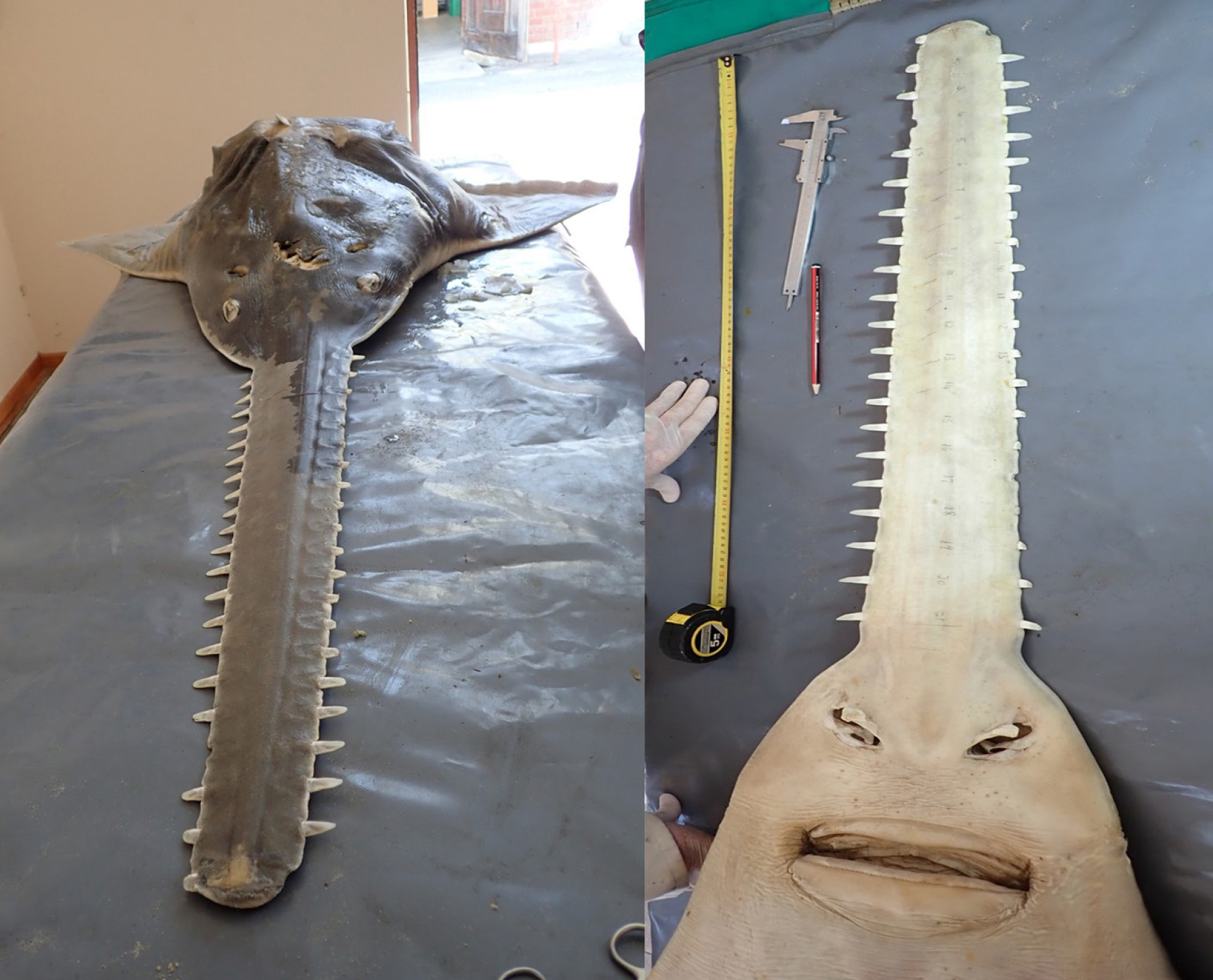
All five species of sawfishes (family: Pristidae) are currently Critically Endangered. Two species have been recorded in South African waters, Pristis pristis and P. zijsron, both of which are regarded as lost in this area, due to the absence of any local records since 1999. Of the two, P. pristis was by far the rarer, with only seven confirmed records from five specimens since 1951; the most recent was in 1985. This species was rediscovered in September 2025 when the decomposing body of a 3.5 m total length male washed ashore close to Bhirha River Mouth, approximately 70 km north of Port Alfred, Eastern Cape, which is the southern limit of its distribution in South African waters. Publicity given to this finding resulted in the reemergence of a 1955 record of P. pristis from the Touws River at Wilderness and a newly-uncovered 1962 record from Cape St Blaize, in the Western Cape, which are 485 km and 540 km southwest of Port Alfred respectively, and therefore represent a substantial range extension along the South African coast. All the South African records of this species are large (> 3.3 m) individuals, which are likely to be highly mobile, with significant dispersal capability. In the absence of any evidence of females or nursery grounds in South African waters, these individuals are assumed to be vagrants that have swum considerable distances south from Mozambique, where there is formal protection for sawfishes but fishing pressures remain high.
Downloads
Published
How to Cite
Issue
Section
License
Copyright (c) 2026 Geremy Cliff, Kevin Cole, Jennifer Olbers, Bernadine Everett

This work is licensed under a Creative Commons Attribution 4.0 International License.
All articles in the Journal of Lost Species are published under the Creative Commons Attribution 4.0 International License (CC BY 4.0), which permits unrestricted use, distribution, and reproduction in any medium, provided the original authors and source are credited. Authors retain copyright and grant the journal the right of first publication under this license.